

12 hours later, the plane touched down on the tarmac of Tokyo’s Narita airport.
It was 5pm local time and already dark outside. I was so tired I could barely open my eyes. I now began to see why the cabin attendant had reached for a vampire analogy; the bags under my eyes were so pronounced, I looked like I would be celebrating my Sweet 600th birthday.
Luckily my guardian angel Char was waiting in the arrivals lounge ready to take me back to her flat. A great friend from university, Char was one of the main reasons for my stopping in Japan. She had recently bagged a teaching job in Tokyo and her great knowledge of Japanese and appreciation for the culture makes her the perfect person to explore a city with.
The next day, I awoke with a pounding head. Having hoped I would drift off for a refreshing sleep, I had found myself wide awake at 2am. As I would find out in the coming days, the 9 hour time difference between Japan and the UK can be a real kick in the unmentionables. Despite the jet lag, I tried to push through, as it would be our only full day together. Those sights wouldn’t see themselves!
We hopped on the subway. Coming from the UK, Japanese stations are a thing of wonder. The trains in Tokyo are clean, spacious and actually smell quite pleasant! Neat boxes painted on the platform floor denote where people boarding the train should queue and stern uniformed guards ensure that trains leave on time. During commuting hours, there are also carriages just for women, introduced to prevent harassment.
Stations even have individual ‘Hassha Merodii‘ or “train departure melodies”. When the doors are about to close, a jaunty little theme tune plays to let passengers know that it’s time to jump onboard or risk getting squished. They were all written by the same man, Japanese music producer Minoru Mukaiya, who has composed around 200 jingles for more than 111 train stations in Japan.
Several jingles later, we got off the train at Asakusa. We passed through a busy market and encountered a line of lean men in very tight leggings (phwoar) advertising their hand drawn rickshaw services. I was pleased to see that from Cambridge’s punting guides to Asakusa’s rickshaw men, the phenomenon of men trying to lure tourists into a ye olden vehicle with made-up facts and dubious flirting is one that spans the globe.
We headed towards one of Asakusa’s main attractions- the Sensoji, the oldest temple in Tokyo.
The gate to the Sensoji is an imposing structure, featuring statues of Fujin (the god of wind) and Raijin (the god of thunder) who guard the temple from natural disasters.

“Kaminarimon gate of Sensoji Temple Tokyo” by Ankur Panchbudhe is licensed under CC BY 2.0.
Beyond the gates is one of the oldest shopping streets in Japan. Here, stallholders were selling traditional Japanese snacks and souvenirs, nearly all of which involved sweet red bean paste, a Japanese staple. The sweet jam seems to be as ubiquitous here as butter is in the UK. It tastes as if someone slipped on a banana skin and let a can of kidney beans go flying into a vat of strawberry jam. I’m not sure if it’s just Stockholm syndrome, but I’m actually starting to like it.
As the Japanese national anthem famously goes:
‘Beans, beans good for the heart, the more you eat, the more youuuuu- the more you eat,
The more space you get on ye olden shopping street’
Roughly 9.2 million people call Tokyo home and it seemed that nearly all of them had decided to visit the market that day. Dodging snailing families hunting for souvenirs and their rogue umbrella spokes, we mercifully made it to the main hall with our eyes intact.
We spent some time taking in the impressive gilded outer sanctum. It was a beautiful room shielded by a wire screen. People solemnly queued in front of it to pay their respects to the goddess Kannon, to whom the temple is dedicated. Some people tossed lucky coins into a box in the hope their prayers might come true.

Inside the main hall there was also the chance to pick fortunes. For a small fee, you shake a container which holds around 100 numbered sticks. You pick a stick and find the corresponding drawer in a chest full of paper fortunes. Good fortunes may be kept, bad fortunes must be ‘sealed’- tied to a metal grid and left behind to stop them coming true.
Some people were even stood in the courtyard burning their bad fortunes. I imagine theirs read something like:
‘Any woman you fall in love with will mysteriously leave you for Pete Davidson’
or
‘The next time you go to eat strawberry jam, you’ll find it’s made of beans.’


I don’t know why Char’s smiling in the photos. We both got bad, BAD fortunes and hastily knotted them to a pole.

Our next stop was the Tokyo Sky Tree. Against our better judgement (‘It’ll be clearer at the top, we’ll be above the clouds!!’) we decided to pay to ascend the 634 metre tall building on what was arguably, a very overcast day. As you can see, the view was stunning and well worth a total sum of 13 English pounds.

We tried to catch a brief glimpse of the cityscape below us but from what we could see, it may as well have been Milton Keynes outside. Regardless, it was a fun experience; we had a great time catching up and indulging in the Japanese custom of collecting ‘commemorative stamps’ placed around the tower.
Hide and Seek Score:
Tokyo-1 Lucie and Char – 0
Our final stop was Shibuya Crossing, the busiest pedestrian crossing in the world, where ten traffic lanes and five major light-controlled crossings converge. I was surprised how despite the heavy footfall, the flow of people seemed very well managed.
Once again, guards in smart buttoned uniforms and officer’s caps ensured everyone behaved in an orderly manner. In Japan there is a uniform for everything. Tokyo feels like a Village People music video, but if the Village People had taken a course in Business Management and could fine you for breaking the highway code.
It was a crazy multi-sensory experience. Unlike Oxford Circus or Times Square, the surrounding billboards also come with loud audio. When the lights turned green, we fought our way across to the other side to a soundtrack of zaps, boings and animated product voiceover. It was intense and strangely combative. Suddenly ‘Animal Crossing’ had a whole new meaning, as everyone jostled their way to safety like panicked creatures in a David Attenborough documentary.
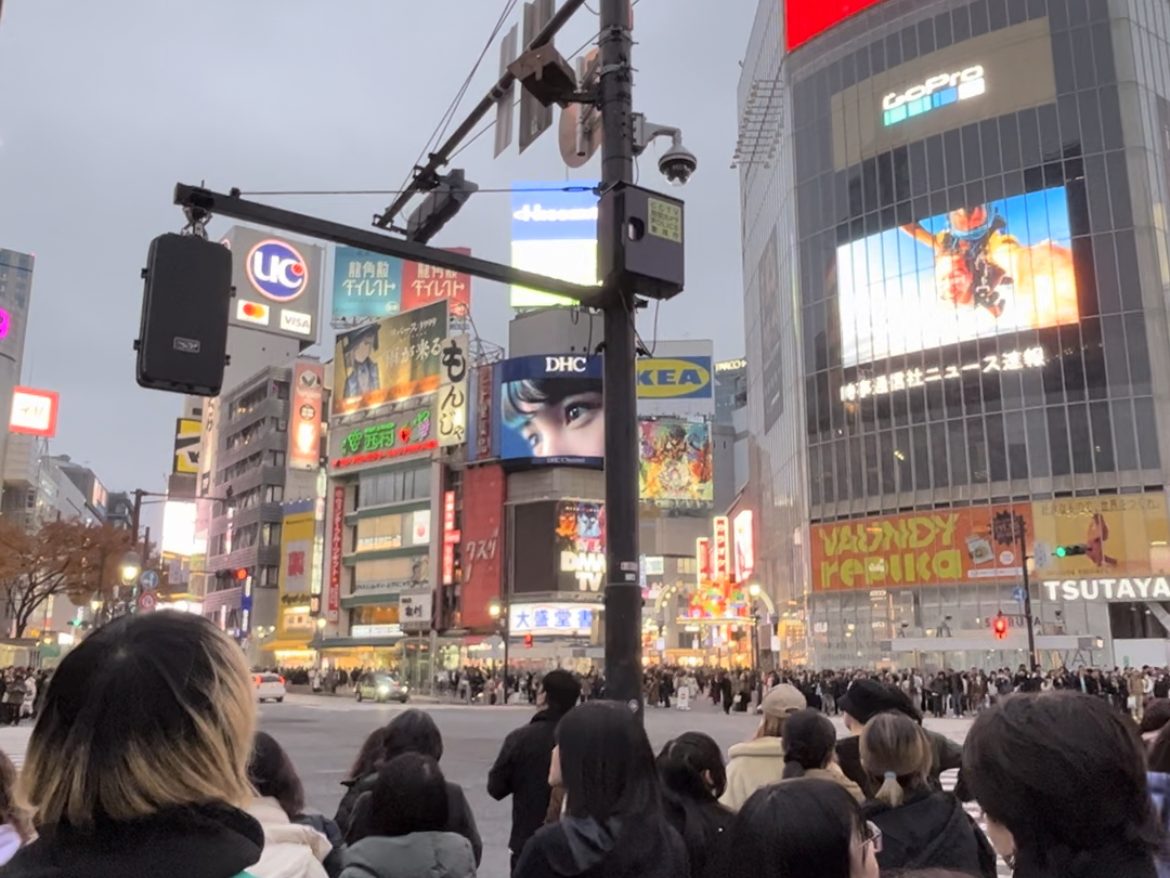
Sadly, by this point the bad fortune, or more likely jet lag, caught up with me and I began to feel queasy and sleepy. We abandoned plans for dinner and returned to the flat. My insides felt as puffed up as my crisp packet had been on the plane. Suddenly 3 weeks of solo backpacking didn’t seem like such a good idea…
Find out what happened subsequently in the next blog!
 lucieintheskywith.com